Sunday, January 29, 2012

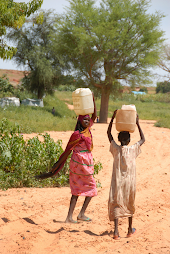
Walk for Water for World Water Day and Global Youth Service Day

Are you looking for a great activity to do with your students? 
Please join
 H2O for Life and  "Walk for Water"
If possible, schedule your walk between
 March 22- World Water Day, and April 22- Earth Day and Global Youth Service Day.


A Walk for Water is easy to organize and an effective way to raise local community awareness about the global water crisis while raising funds to support a school in a developing country that deperately needs water.

How Can You Get Involved?
  • Engage Participants!  Enlist participation from your classroom, school, group of friends, church, family- get the theme?  Any group can organize and participate in a walk for water.  The more people that you can gather to join you, the better it will be, but remember: a small group of people can make a difference. 
  • Set the challenge.  Can each individual gather a certain amount of donations?  $20, $50, maybe $100!  Remind them that through H2O for Life, their dollars are matched by the implementing NGO organization, doubling the amount raised.
  • Choose a school from our partner list:: http://www.h2oforlifeschools.org/partnership-information/available-schools/public-schools/  OR you may donate proceeds to a "school in need". 
  • Plan your walk with the help of our walk guide that is available online.  You'll find flyers for the event, pledge sheets and a guide that will provide tips for creating an amazing event. 
  •  walk guide: http://www.h2oforlifeschools.org/resources/curriculum/walk-guidlines/
  • Pick a date and have a great time while raising funds that will change lives for students in your partner school!
  • Take photos and write a short story about your event that we will share with our facebook and website  followers.   We love to publicize success!
  • Would you like to order t-shirts?  We can help you with that.  Please contact us at: info@h2oforlifeschools.org   We work with a company that will provide affordable t-shirts for your walk.

READ the story about a school that participated in a walk last school year!

http://www.h2oforlifeschools.org/2011/06/st-anthony-middle-schoolers-raise-10000-for-h20-for-life/


Can't walk between March 22- April 22?  Not to worry!  Schedule your walk before the end of the school year, and help a school receive water!  Every dollar makes a difference.  Be part of the solution!
Make it part of your school year to organize a walk for water every year!
The solution is within our reach, and we CAN make it happen!

Monday, January 9, 2012

Happy New Year! Start out the year with a MLK day outreach with your school

Happy New Year to all our H2O for Life friends.  We hope you had a restful holiday and are ready to ramp up your school projects.  Martin Luther King Day will be celebrated on January 16th.  For many school districts, it is no longer a day off, but a DAY ON focusing on service.  We have several ideas that you can use to raise awareness in your school and in your community about the water crisis. Also, please visit our friends at ysa.org to learn more about a Semester of Service beginning on MLK day.

Create a WATER DROPLET WALL.  I know that we mention the wall idea often, but it is so easy and so effective!  Students cut water droplets out of blue paper and go into action, selling each drop for $1.00.  (you ,of course, can charge more if you wish)  Encourage students to write a message on the drop,or have a message already printed that just requires a signature, such as- everyone needs water!  The wall is an impressive visual for students, teachers and parents to see as they enter your school.


We also encourage an initiative called:  Tap into Tap Water.
http://www.h2oforlifeschools.org/download/_2011/H2O_TapIn_Flyer_LTR.pdf

The flyer will tell you everything you need to know to raise funds through drinking tap water.

It's never too early to begin publicizing your H2O for Life connection.  Even if you are not planning to organize an event until spring, these ideas can raise awareness and jump start your project.

If you have other great ideas that have worked for your school please share them with us.  We are always looking for ideas that other teachers can use.

Again, Happy New Year, and let's all make it a great one!

Wednesday, November 23, 2011

Stillwater Junior High Raises the bar!

Stillwater Junior High School, located in Stillwater, MN recently hosted a terrific event.  Students read the book, "They Poured Fire on us From the Sky", and then invited "Lost Boy" speaker John Dau to speak to the community in Stillwater.  Over 500 people attended the evening event and learned about the hardships endured by Dau during his relocation from Sudan.  Students were amazed at his story.  In conjunction with the book, Stillwater Junior High is raising funds to help build 2 wells for South Sudan.  They have already raised over $7500 this year, with a goal of $10,000!  Teachers and students, along with project lead teacher Sara Damon- we salute you and your efforts!

The video below shares a few commens by students and John Dau.

http://www.kare11.com/video/default.aspx?bctid=1267583311001

Friday, November 18, 2011


World Toilet Day- 2011


World Toilet Day should be about demanding better work, better results, and more thoughtful programming.
Lend your social networking voice via Twitter or Facebook to raise attention to World Toilet Day.

 I wanted to share with you a provocative article that Water For People's CEO, Ned Breslin wrote in response to the usual clamor around World Toilet Day, "More Funding for Sanitation Projects," as is echoed in this article in the Independent. I hope you'll find Ned's response, which was published by AlertNet, thought provoking and informative.

Commitment to Everyone – My Wish for World Toilet Day

By Ned Breslin


This Saturday, November 19, we will celebrate World Toilet Day. The day has been vital to raising awareness about the 2.6 billion people worldwide do not have access to a hygienic toilet.

Not having a toilet is a disgrace and a major health catastrophe, directly contributing to the death of approximately 4,000 children worldwide every day.

Yet coupled with this public health disaster is the growing realization that the Millennium Development Goal (MDG) for sanitation is perhaps the most off track MDG target of all.

The MDGs are eight measurable goals to be achieved by 2015 established by the United Nations (U.N.) in 2000 to try and alleviate global poverty.

Massive global sanitation problems combined with the utter failure to even remotely reach MDG targets place the sanitation sector at a crossroads.

I have worked in sanitation for over 20 years, and today was another sad day like too many other sad days I have encountered when focused on sanitation. I spent this morning with Palmiera, a mother who lives in the mountains of Bolivia.

She shows me a small building that is immaculately constructed with brick and cement next to her house. As I come around the corner I see it is a toilet, with a large international NGO (nongovernmental organization) logo, with a smaller foreign aid donor emblem just below, painted on the side to pronounce to the world the NGO and donor’s benevolence and presence.

Entering the toilet, my heart sinks as the latrine is broken – the toilet seat is so dirty that dust flies everywhere as I open it, the water needed to make the toilet work had stopped flowing years ago, and the toilet was now a shed to store the family’s agricultural commodities that will eventually be sold. It’s a toilet in theory only.

Set against this failure at Palmiera’s house – which is hardly unique – is a shallow debate about foreign aid that states simply that billions of people do not have safe sanitation (true) and that the solution is more foreign aid that is better targeted at countries who are most off track in terms of sanitation coverage (questionable at best).

Aid, it is argued, is not only misaligned but most importantly not sufficient to create a world where every family, every school and every clinic has access to a toilet that removes pathogen-rich feces from the immediate environment.

We are losing the battle, it is argued, because governments worldwide are not playing their part, not contributing enough to rid the world of this horror.

Talk to the most thoughtful field practitioners in the sanitation sector and you might be surprised to hear that the math that reads low sanitation coverage + increased foreign aid = more sustainable sanitation access does not really add up.

Why?

Well, we have tried pushing money into sanitation for decades with little effect. Some would even argue that foreign aid for sanitation, which has almost always translated into latrine construction projects despite overwhelming evidence that such approaches do not work, has fundamentally distorted the sanitation market to the detriment of the poorest.

Just ask Palmiera, as foreign aid did not help address her sanitation problem at all. Her toilet was built, it does not work, and Palmiera is no better off as a result of this investment.

My wish for World Toilet Day is consequently somewhat different from all the noise that you will hear on this extremely important day. The noise will focus on raising awareness of the sanitation problem worldwide and pushing people to donate more and more money to eradicate sanitation poverty.

But sanitation agencies do a disservice to the people they work with around the world like Palmiera if the latrines that actually are built do not work or last. They do a disservice to American taxpayers and philanthropists when they take money for transformative work that fails to transform.

And they run the risk of discrediting the entire sanitation movement if World Toilet Day does not demand better work, better results, and more thoughtful programming from those shouting the loudest for more money.

Conventional sanitation aid needs to be radically overhauled and progress monitored over time. New philanthropy understands that the problem is not that we do not have enough money for sanitation aid but rather that the money we actually have is so poorly spent.

Catalytic investments that minimize latrine subsidies and try to create sanitation markets supported by local businesses show great promise without a single dollar of aid being used for latrine construction.

Initiatives like Community-Led Total Sanitation appear to be scaling in some of the poorest parts of the world with significantly less financial requirements than was once considered just and reasonable because these programs tap into local financial resources for solutions rather than relying on conventional aid.

And the creative use of local financial institutions and microfinance continue to show an alternative funding model that does not require on-going foreign aid support.

The sanitation sector needs to change its tone, from demanding more money to demanding to be held accountable for better results from communities in developing countries and donors and philanthropists who want their investments to truly solve the global sanitation crisis.

We need to think differently about the reasons why 2.6 billion people do not have access to sanitation worldwide and have the courage to accept that we, as a sector, have failed far too many people like Palmiera.

World Toilet Day will be a great success if those of us on the frontlines of this sanitation battle commit to a new way of working, with greater transparency and more thoughtfulness, so that the next time Palmiera gets a latrine she has it for life.

Submitted by:
John Sauer

Assistant Director Thought Leadership

Water For People

Monday, October 31, 2011

H2O for Life collaborates with the World Savvy Challenge

Are you looking for more ways to involve your students in terrific programs?  Well, look no farther.  H2O for Life is collaborating with the World Savvy Challenge.  If your students are already participating in an H2O for Life project, getting involved with World Savvy will be easy.  It provides an opportunity for your students to prepare a presentation and show the rest of the country what they have learned.  Read more about how to get involved with World Savvy below:


National Online Pilot Program

H2O For Life Schools are invited to participate in the World Savvy Challenge, a project-based learning program that builds students knowledge & skills for global competence.

How it works:

Students work in teams of up to 10 in class or afterschool

Students chose a topic and problem related to the theme of Sustainable Communities and engage in in-depth research on their theme using World Savvy resources as a guide

Students participate in the Savvy Scavenger Hunt to build their knowledge of the theme and awareness of current events

Students develop local, national and global level solutions and develop a knowledge-to-action plan for how they can take action on the issue

Students present their research & solutions in either a website or documentary and submit it online along with their knowledge to action plan to compete for prizes against students from around the country

Competing students also participate in an online action roundtable, where they work with peers from other schools to discuss a related real world problem

Students who score in the top 10% of online entries are eligible to submit their knowledge-to-action plan to the national online finals where they have a chance to win up to $500 to implement their plan over the summer

World Savvy provides teachers with the necessary resources to embed these topics into their existing curriculum, including a program guide book, a World Savvy Monitor on Sustainable Communities, a Sustainable Communities Collaborator’s Guide, bi-weekly resource emails, professional development opportunities, grading rubrics, and student research support.

This is a great chance for H2O for Life students to deepen their knowledge of the connections between water & sustainability and share their research & solutions with a national audience!


Team Registration Deadline: December 15, 2011

Competition entries due March 15, 2012

Register online at http://wsc2012online.eventbrite.com/

Cost: $100 per team of 10 students; $50 for additional teams. Includes all digital materials.


For more information, please contact Taylor Watson at taylor@worldsavvy.org or 415-813-1682.

Thursday, October 27, 2011

Stillwater Junior High School Hosts John Bul Dau

Tuesday night was a busy evening for Stillwater Junior High School.  Stillwater is located in Minnesota, and has been an H2O for Life partner for the past 3 years.  Teacher, Sara Damon, focuses on Sudan and conflict as one of her teaching modules for AP Geography.  The students read the book "They Poured Fire on us From the Sky."  They study the conflict in Sudan, and also discuss the mass exodus of the "Lost Boys". As a culminating community activity, John Bul Dau, author of the book, "God Grew Tired of Us" was invited to speak at the Junior High and spend two days in geography classrooms with the students.  Over 500 tickets were purchased for the event, and several area non-profits and a local book store also were in attendance.

John is a great story teller, and had the crowd mesmorized as he outlined his life as a youth in Sudan, a refugee, and immigrant to the US, and how he is now giving back to his native country.  He used humor, and powerful stories to engage the crowd.  Mrs. Damon has developed great curricular ideas that can be used in your classroom, and it can be found in our H2O for Life tool-kit online.

Stillwater Junior High hosted a walk for water, sold t-shirts and hosted this wonderful event to raise over $7500 so far this year wells in Southern Sudan.  But they aren't done yet!  Their goal this year is to raise $10,000 to sponsor two wells for Southern Sudan.  If you would like to help them reach their goal, make a donation online and designate, Stillwater Jr. High as the recipient.  OR.... choose a school partner, engage your school and make a difference in the world.


Congratulations Stillwater Junior High School. Your actions are changing the world.

Monday, October 24, 2011

October is Global Handwashing Day/Month!

Highlighting the “H”: on Global Handwashing Day


Now in its fourth year, Global Handwashing Day brings attention to the often forgotten “H” in WASH, hygiene. When something as simple as handwashing with soap can help reduce diarrhea rates among children under five by almost 50 percent, it is imperative that this simple practice is not overlooked.


About 34 percent of people wash their hands with soap at critical moments – i.e. before handling food and after using the toilet. The key to increasing the practice of handwashing with soap is to promote behavioral change through motivation, information and education.


There are a variety of ways to increase awareness about the importance of handwashing, including high-profile national media campaigns, peer-to-peer education, hygiene lessons for school children and encouraging children to bring home the lessons they have learned at school to their families and communities.

It is never too late to teach children that handwashing is important.  H2O for Life-besides providing water projects and toilets to schools, also focuses on handwashing and hygiene education.

What can you do to raise awareness and change behaviors in your family and school?  What can you do to help a school around the world have access to a handwashing facility?  Choose a school from our list, and take action today!